Manual / Reference
Settings reference
All settings live under the integration’s Configure menu: Settings → Devices & Services → BavarianData → Configure. Every action step and every option is listed here.
The menu has three kinds of entry: stream setup, settings screens, and one-shot fetch actions (which spend API quota). Changes to settings screens apply immediately — the integration doesn’t reload the entry, because BMW allows only one concurrent stream per account and a reload risks racing the reconnect.
The Configure menu#
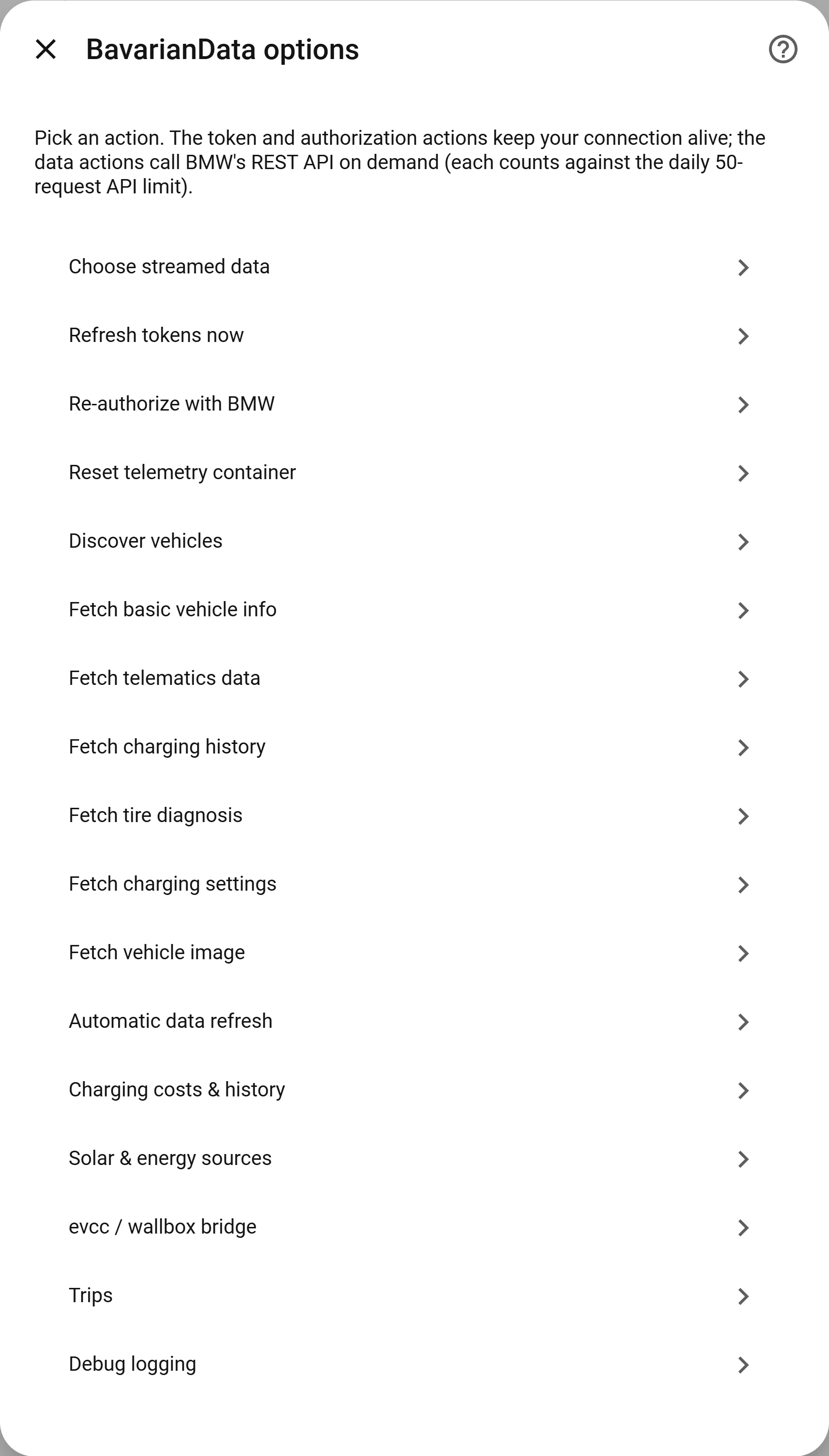
The menu labels below are exactly as they appear in the UI.
| Menu entry | Kind | What it does |
|---|---|---|
| Choose streamed data | setup | Re-open the cluster picker, then activate the fields with the one-click Activate BMW data bookmarklet (same activator as guided setup). Additive — it adds the chosen clusters to the live stream but never removes fields you already stream. |
| Refresh tokens now | action | Force an OAuth token refresh. |
| Re-authorize with BMW | action | Re-run device auth (after BMW invalidates the token). |
| Reset telemetry container | action | Clear the stored HV container id/signature so it’s rebuilt on the next fetch. Use if telematics fetches start failing after a descriptor change. |
| Discover vehicles | action ⚡ | Fetch vehicle mappings and add any car not yet known as a device. See Services. |
| Fetch basic vehicle info | action ⚡ | See Services. |
| Fetch telematics data | action ⚡ | ” |
| Fetch charging history | action ⚡ | ” |
| Fetch tire diagnosis | action ⚡ | ” |
| Fetch charging settings | action ⚡ | Location-based charging settings. ” |
| Fetch vehicle image | action ⚡ | ” |
| Automatic data refresh | settings ⚡ | Catch up with BMW after Home Assistant starts — below. |
| Charging costs & history | settings | Price source, retention, statistics — below. |
| Solar & energy sources | settings | Where each charge’s energy came from: PV, house battery, grid — below. |
| evcc / wallbox bridge | settings | Publish the car’s live state to MQTT for a charge controller — below. |
| Trips | settings | Work zone, default type, commute stop tolerance, address resolution and route recording — below. |
| Debug logging | settings | Verbose logging toggle — below. |
⚡ = spends one (or more) of your 50 requests / 24 h.
Automatic data refresh#
Screen: Configure → Automatic data refresh.
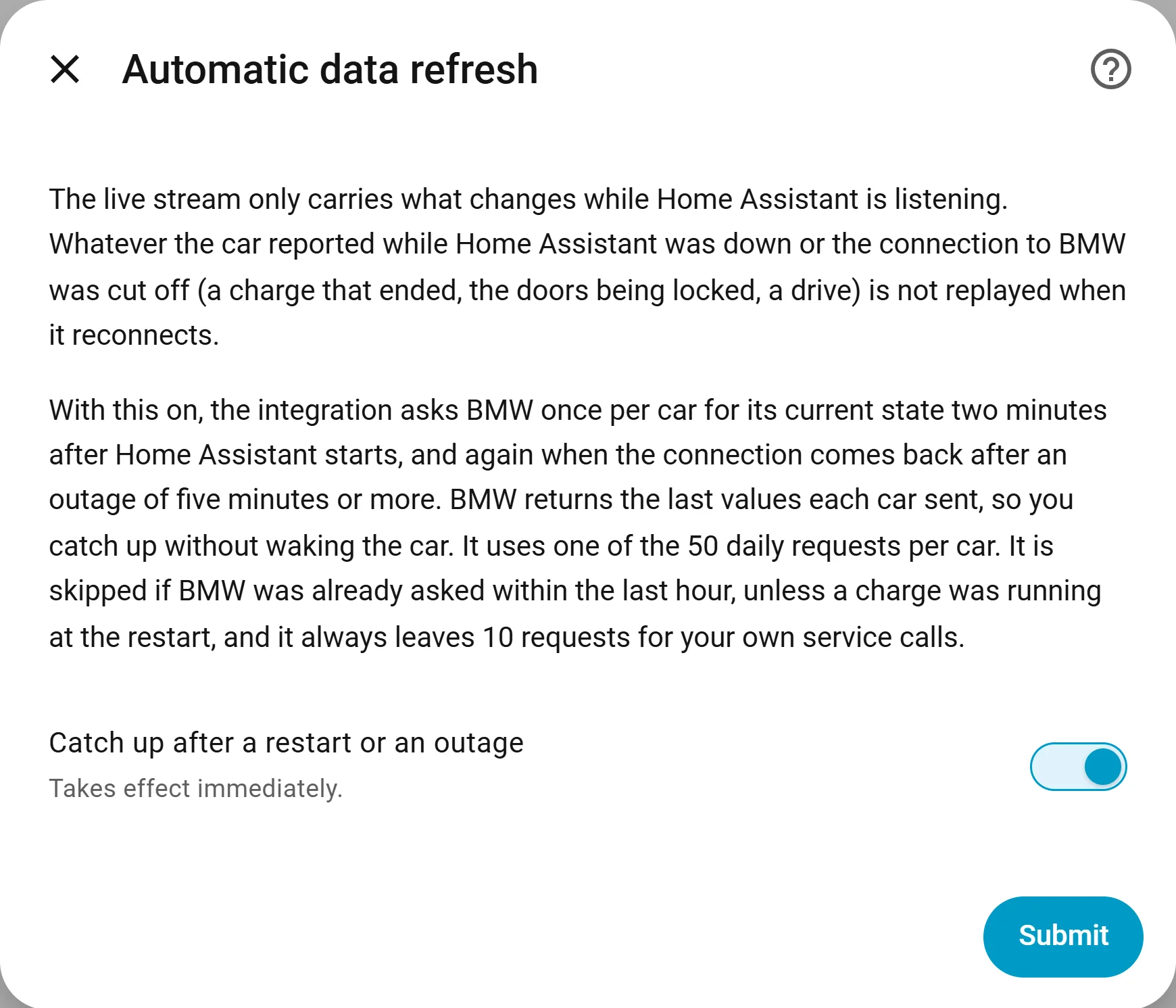
The live stream only carries what changes while Home Assistant is listening. Whatever a car reported while Home Assistant was down, or while a network outage cut the connection to BMW — a charge that ended, the doors being locked, a drive — is not replayed on reconnect, and a car charging at steady power can stay silent for hours afterwards. So the integration asks BMW once per car for its current state: two minutes after a start, and when the connection comes back after an outage of five minutes or more. BMW returns the last value each car sent, so this catches up without waking the car; it cannot produce a newer reading than the car last sent.
| Option | Values | Meaning |
|---|---|---|
| Catch up after a restart or an outage | on/off | Default on. One request per car of your 50 a day. Skipped when BMW was asked within the last hour (the daily refresh or a manual fetch count too), so restarting repeatedly, or a connection that keeps dropping, costs nothing more; a charge that was running at a restart is still checked if the last request is over half an hour old. Always leaves 10 requests for your own service calls. Takes effect immediately. |
A charge running at the restart is settled by this answer: still charging and it carries on as the same session, stopped and it is recorded as ended — see Restarting while the car is charging.
Charging costs & history#
Screen: Configure → Charging costs & history. See Charging history & cost for the concepts.
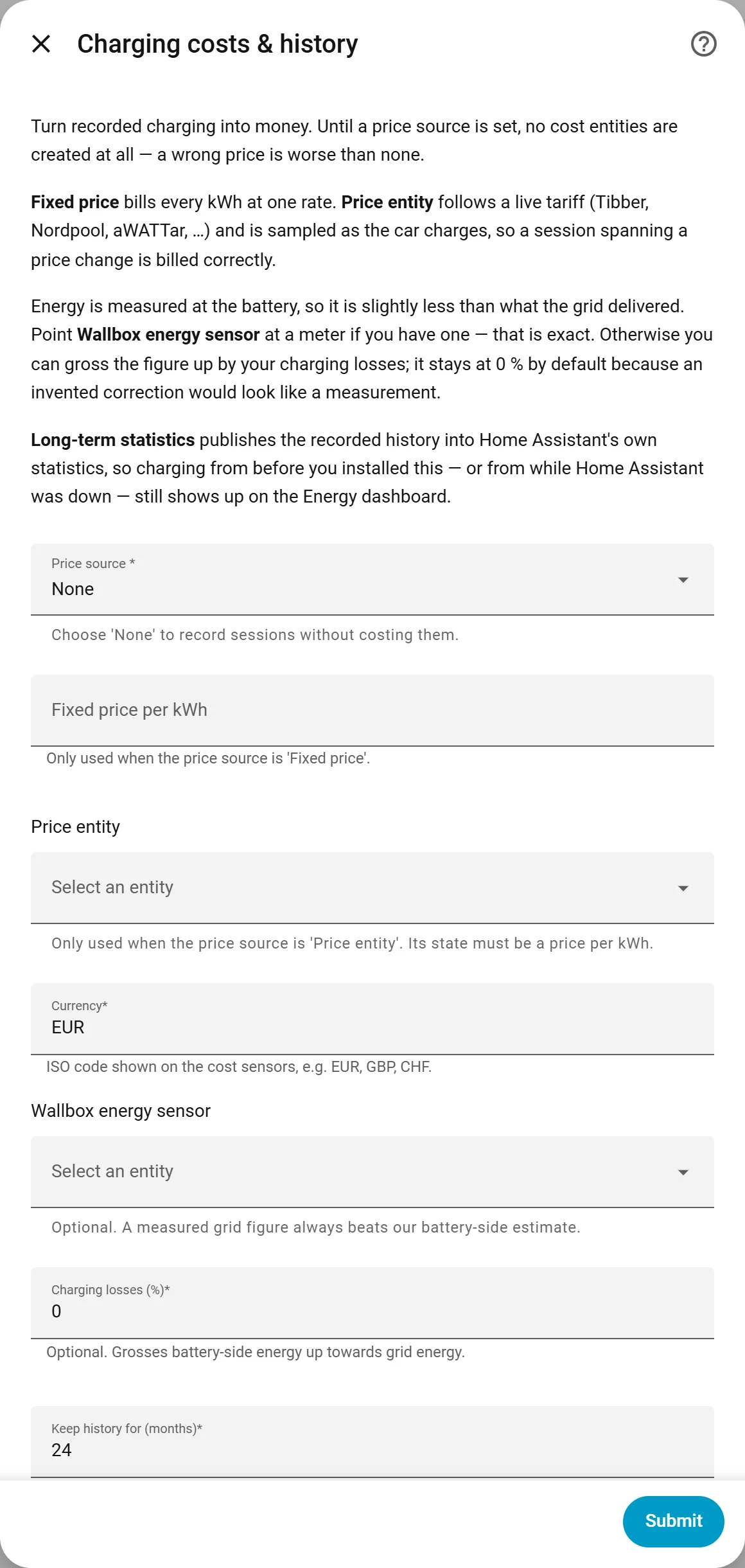
| Option | Values | Meaning |
|---|---|---|
| Price source | none · fixed · entity | How energy becomes money. none creates no cost entities at all. |
| Fixed price per kWh | number | Price per kWh, when mode is fixed. Required in that mode. |
| Price entity | sensor / input_number | Live price source (Tibber/Nordpool/aWATTar), when mode is entity. Sampled while charging. Required in that mode. |
| Currency | text | Currency code for the cost entities. |
| Wallbox energy sensor | sensor | Optional. The wallbox’s cumulative energy total (total_increasing, not a per-session counter). Its measured grid figure replaces the battery-side estimate in the session record, the monthly totals and the cost. Only read for charges in your Home zone, and refused when it can’t be right — see the bridge page. |
| Charging losses (%) | 0–30 | Grosses the battery figure up by your losses. Default 0 (no invented correction). |
| Keep history for (months) | 0–120 | How long to keep recorded sessions/trips. 0 = keep everything. |
| Publish to long-term statistics | on/off | Mirror history into the Energy dashboard. Turning it off deletes the published series. See Energy & statistics. |
Solar & energy sources#
Screen: Configure → Solar & energy sources. See Charging history & cost → Where the energy came from for what it does with these.
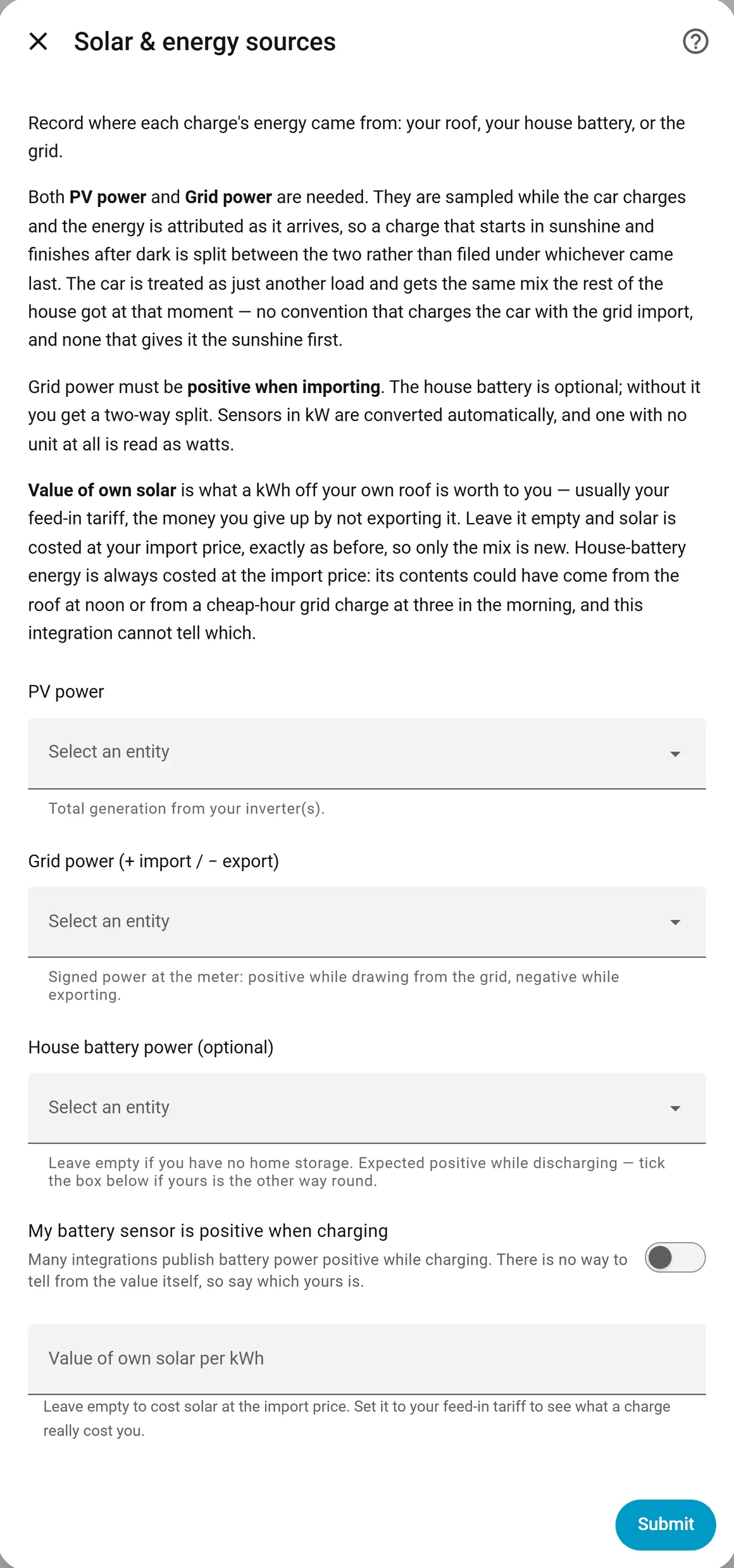
| Option | Values | Meaning |
|---|---|---|
| PV power | sensor (power) | Total generation from your inverter(s). Required for any attribution. |
| Grid power (+ import / − export) | sensor (power) | Signed power at the meter: positive while importing. Required. |
| House battery power | sensor (power) | Optional. Without it you get a two-way PV/grid split. Expected positive while discharging. |
| My battery sensor is positive when charging | on/off | Flips the sign convention. There is no way to tell from the value itself, so this has to be stated. |
| Value of own solar per kWh | number | What a kWh off your own roof is worth — usually your feed-in tariff. Empty = solar is costed at your import price, exactly as before, and only the mix is new. |
Both power sensors are needed: with only one, the split would have to assume the other. Sensors reporting kW are converted automatically; one with no unit at all is read as watts.
The pickers list sensors whose device class is power. If your own template
sensor isn’t offered, give it device_class: power (and a unit_of_measurement
of W or kW) and it will appear.
evcc / wallbox bridge#
Screen: Configure → evcc / wallbox bridge. See evcc & wallbox bridge for the concepts, the topic table and the troubleshooting.
Publishes the car’s live state onto your MQTT broker so evcc, openWB or a Node-RED flow can read a state of charge that costs no API quota. Requires the MQTT integration to be set up in Home Assistant — the bridge publishes through it, so there is no broker host or password to enter here. Switching it on shows a second screen with the ready-to-paste evcc configuration.
| Option | Values | Meaning |
|---|---|---|
| Publish this car to MQTT | on/off | Default off. It puts the VIN and the car’s state on a broker other things can read. Switching it back off removes the published topics. |
| Topic prefix | text | Topic root; everything lands under <prefix>/<VIN>/. Default bavariandata. Slashes are trimmed and an MQTT wildcard falls back to the default. |
| Publish retained | on/off | Default on, and best left on: it is what lets evcc find the state of charge the moment it starts rather than waiting for the car to speak again. Turn off only for a broker that refuses retained messages. |
Trips#
Screen: Configure → Trips. See Trips for the concepts.
| Option | Values | Meaning |
|---|---|---|
| Work zone | zone entity | Drives commute classification (home↔work). |
| Default type | Private / Business / Leave unclassified | Default Private. What every trip that isn’t a recognized home↔work commute is filed as. Always just a starting point: a correction on the card is never overwritten. Pick Leave unclassified to triage each trip by hand. |
| Commute stop tolerance | 0–180 min | Default 30. How long the car may stand between two drives for both to still count as one commute — the supermarket on the way to work. 0 switches chaining off. Stops under ~5 min never split a drive at all. |
| Resolve addresses | on/off | Off by default. When on, trip endpoints outside any zone are reverse-geocoded via OpenStreetMap; the address string is stored, never the coordinates. |
| Record route | on/off | Off by default. When on, each new trip stores its GPS track — coordinates along the drive, each stamped with its time ([lat, lon, t], t = seconds since start) — so a map can draw and replay the route. The only setting that persists raw coordinates, your exact start/end included. Served via get_trips; never in the export. |
| Trip-capture diagnostics | on/off | Off by default. A troubleshooting aid for improving trip detection: logs the raw substrate (every GPS fix with cadence/latency, the close-timer lifecycle, full segment batches, a per-message descriptor firehose and a per-trip post-mortem) under [trip.*] tags, and writes bavariandata_trip_capture.ndjson to your config folder. Independent of Debug logging. Verbose and contains GPS/VIN — turn it on for a test drive and back off. See Troubleshooting. |
Debug logging#
Screen: Configure → Debug logging.
| Option | Values | Meaning |
|---|---|---|
| Enable debug logging | on/off | Off by default. Gates the integration’s verbose logging (separate from HA’s per-integration log level). Verbose and can include VIN/GPS — leave off unless chasing a problem. Applies immediately. With more than one BMW account set up, the log level is shared: logging stays verbose while any entry has this on, and covers every account (Multiple cars & accounts). |
Hidden overrides#
A few advanced options aren’t in the menu and are only set via the hidden overrides mechanism / imported options. Most users never touch them.
| Option key | Meaning |
|---|---|
mqtt_keepalive | MQTT keepalive interval for the stream client. |
diagnostic_log_interval | How often the diagnostic heartbeat is logged. |